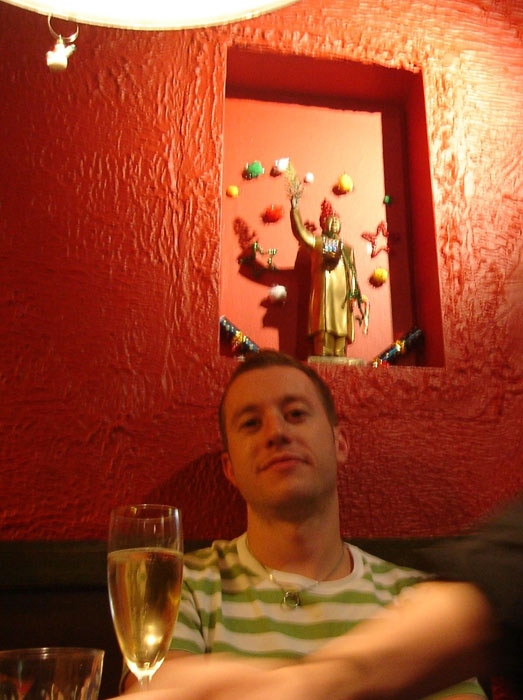
mood: a little tired. state i'm in: haigh's chocolatey bliss. tune: benjamin diamond 'little scare'... thanks karl! xo..
so the survivor lives on to tell another day. there has been much anticipation of the replacement as leader of the liberal party of john howard these last weeks, but the tension and turgidity seems to have resolved in mr howard's favour by the conclusion of the liberal party and coalition meetings this morning... for now, at least.
regardless of the outcome of the forthcoming federal election, mr howard will likely not be prime minister for very much longer. chances are he is facing defeat at the ballot box by year's end. this would pave the way for treasurer peter costello to become leader of the opposition post-election, but he would have a hard time generating any sort of positive results in opinion polls or a subsequent election. he is neither popular with his own party apparat or within the electorate. at some point the torch would have to be passed to another contender. if mr howard does win the next election, i still believe it would be unlikely that mr costello would ascend to the pinnacle of the nation's political landscape.
a shift in leadership now to mr costello would probably only worsen the election outcome, but would remove not one but two hurdles in the way of possible leadership contenders, and real prime ministerial potentials, alexander downer or malcolm turnbull, should he indeed be defeated. one of these two or another individual would be elected leader by the party and mr costello, with a forgotten mr howard, could be swept into the dustpan of liberal party leadership history. but do any of these party aspirationals have the gumption to come forward now and push the issue?
to elect someone other than mr costello as a leader at the moment would be nothing short of the execution for that individual's chances of ever leading the party and the country. therefore, it is a virtual impossibility that we will see such a thing occurring.
personally, i would rather mr howard stay on and face the ballot box, humiliated thence.
mood: excited. state i'm in: the big ugly electric blue lounge. tune: theme from 'the bold and the beautiful'.
last month, idaho senator larry craig pleaded guilty to charges of 'indecent conduct' after making advances on an undercover police officer at the minneapolis-st paul international airport. this is the same man that endorsed his state’s successful anti-gay constitutional amendment, which bans gay marriage, civil unions and domestic partnerships, and is the same man who helped to enact the military's "don't ask, don't tell" policy in the early 1990s. in considering this, his guilty plea to the 'indecent conduct' charge could easily lead one to draw the conclusion that mr craig is a hypocrite. in simple terms, i would say he is, but i would also say that there is likely a reason behind the hypocrisy.
i ask, why would this man feel so compelled to suppress his sexuality i.e. married, children, outwardly homophobic stance? perhaps he himself is a victim of a society so intolerable of diversity in sexual orientation, that being upper crust america.
recent studies in the USA have shown that over 60% of men who use public restrooms as a means to find sex are not heterosexual. in light of this, consider that mr craig is gay or bisexual, and has spent the better part of his life covering up this fact from his family, his friends and colleagues, and, later, his wife and children and the general public, most importantly the conservative constituency that have provided his bread.
whilst mr craig has not confessed to being gay or bisexual, consider this event something of an 'outing' for the man. how terrible would it be if many in the LGBT 'community' responded with nothing but comments the likes of 'he got what he deserved' or 'he's been stricken by the monster he helped to create' or something similar. i can't imagine that such an environment would be conducive to mr craig feeling at all comfortable with any new-found identity.
unfortunately that is almost all i have read. i always think that a gay man or lesbian ought to be the bigger person in such a situation and not be so quick to judge those that are so quick to judge us. i believe we ought to be telling someone in the position of mr craig that we can empathise with his plight rather than just shun the man to the LGBT naughty corner.
mood: tad disgruntled. state i'm in: kronenbourg 1664. tune: david gray "silver lining".
just got a lift home. people are kind.
ok, so i am officially too old to be stamped at the regatta.
the bouncer was checking ID at the pub earlier on a group of patrons, including yours truly. when i produced my licence, all i got was a "nah, it's ok, your as old as me". i said "and how old are you" to which he replied "26". i could only retreat at that stage.
meanwhile, a fair few med people looked hot. haven't been to a med gig in ages, so it was good to relax with them and socalise again for a bit. jeff's a spunk too!
now i have pissed munchies. this health kick gets boring. all i have is jatz crackers...
mood: just a little concerned, but confident. state i'm in: damp. tune: jamiroquai "soul education".
phascolarctos cinereus sexfiendeus:
a koala has been sent on a mission... edinburgh zoo resident chumbee has been living it up in vienna of late as the male koala in the shoenbrunn zoo, bilyarra, seems a little frigid. romantic music, aphrodisiac food and even koala porn have thus far failed to get him in the mood. enter chumbee, and his hyperactive libido.
"chumbee hasn't stopped since he got here," said shoenbrunn zoo manager helmut pechlaner. it seems chumbee has managed to spice things up somewhat and now it is a free for all orgy in the koala enclosure. bilyarra is even getting in on the act. "it has been almost non-stop sex in the koala enclosure ever since," continued the proud zoo manager.
chumbee's global travel aspirations have been bolstered subsequently, with other zoos expressing interest in having him drop by to heat up their koala colonies.
extreme ageism?
in canberra, a man, for some strange reason, became motivated to visit his local shopping centre and charge down a few older shoppers. he allegedly slammed into a man in his 60s, before shoulder-charging a 71 year old woman and knocking her to the ground.
unfortunately the woman had a heart attack moments after getting back up and died later in hospital.
the man has been charged and will have his mental health assessed.
mood: sullen. state i'm in: my own public holiday. tune: the dining rooms "tunnel" (the dining rooms rework).
my heart sunk yesterday when i read federal indigenous affairs minister mal brough's comments on the likelihood that land rights and native title will be abolished or diminished in the near future. to anyone with an inkling of intelligence, mr brough's comparison of current indigenous land rights with communism and collectivism is sheer stupidity.
mr brough said ownership of land needed to be properly mixed with economic opportunity, and that if the balance was right "the people would flourish". for indigenous people to obtain economic opportunity the likes of which mr brough refers to it would require them to sell off and leave their land for a nominal fee, to move to cities such as darwin, cairns and mount isa where more opportunities might exist. in case mr brough has not realised, such plans in the past have failed miserably. to get such a plan to work (which is essentially wholesale assimilation) would require far more investment that any government would be likely to want to make. all i see is a government with a plan to get it's hand on a whole swath of land it has been unable to touch for some time and do with it what it pleases, with contempt for its inhabitants' interests. this impression is further bolstered by the government's refusal to make amendments to its northern territory intervention laws to ensure aboriginal people are compensated for losing control of their land under such an 'emergency' intervention.
at this present stage, neither major political party is championing anything like a policy i would be willing to support on indigenous affairs. right now all i see are a few final nails being driven into the coffin of aboriginal culture and identity. i do not want to one day have to look in history books to be able to experience it.
allow me to introduce the town of robinson river. this town operates under a plan introduced the fraser government in 1977 called community development employment program (CDEP), whereby many of the townsfolk are employed essentially by the CDEP in jobs as diverse as tending the town's animals (which were soon to be used to produce goods able to be sold), building fences and gates for properties in the town to keep animals in and predators out (and earning a few people trade certificates in the process), and running the local store. this town functions remarkably well: there is almost no unemployment, school attendance is very high, abuse (of either children or adults) is not a problem and the people feel a great deal of pride in the jobs they perform, as they are in the interest of their fellow townsfolk.
forgive me if i am wrong, but i believe this town is an example of collectivism working like clockwork.
the CDEP, the mainstay of robinson river, will be disbanded soon as a part the federal government's emergency intervention to attack child abuse and quarantine welfare payments. payments will cease to the individuals previously on CDEP receipts and they will receive quarantined welfare payments. the townsfolks will no longer be employed.
another town that has achieved tangible results for its inhabitants is cherbourg. this is a town that was racked with drug and alcohol dependence and violence perpetrated by many of the town's menfolk. fed up with these issues, a local womens' group was established, and has gone about rectifying the problems through involvement of the whole community with health, education, housing and welfare, and through engaging local and state governments. they have had a great deal of success: the community is dry, and has had only one report of child abuse this year, which was reported and dealt with within the community; the number of children attending school has increased, and health outcomes have also improved. this town is a model of what can be done with some self-determination in a community, and with the support at different levels of government. The community has supported its men, and their behaviour and degree of community involvement has been improved immensely. a mens' group has now been established in cherbourg, housed in a hall on local council-donated land, so the men can teach the younger generation how to be effective community members.
fortunately, cherbourg is in queensland (safe from ludicrous federal interventions) and no initiatives here are to be axed.
if these communities can become so strong simply through self determination and government support at multiple levels, than why are they not be held up as shining lights of how indigenous folks are capable of a degree of independence and success. would it not be foolish to have recommendations from these towns brought into other communities, and, through consultation and self-determination, initiated so that they may also see similar improvements. (many of these recommendations were in the report the federal government was supposed to have acted upon when launching the current intervention, but failed to heed.) without being slightly cynical, solving problems in indigenous communities will not take a month of military intervention, or even a term or two of government.
it would be some time before we could expect to see many individuals from these communities, such as the welding girls from robinson river, take there skills to darwin or alice springs and implement them to make financial gains that could be sent home, perhaps having trained some of the younger townsfolk behind them. but i am confident it would happen. with such initiatives in place, it wouldn't be long before more than just welders would be leaving the towns. there might be plumbers and carpenters behind them, and maybe some boarders going to stay in residential colleges in universities where they may study accounting or health sciences or engineering and take these talents back to their ever more self-sufficient communities, or out into the wider community.
mood: pretty happy. state i'm in: commence week 26... life goes on. tune: eurythmics "there must be an angel (playing with my heart)".
'enjoy rugby in the capital love' is the advertising campaign being used to lure the brits across the channel for the rugby world cup in paris. it is apparently an attempt to use the world cup with some unconventional humour to advertise the fact that "paris is also the capital of humour," or so the line goes from parisian tourism website 'c'est so paris'. rugby in france has had previous brushes with homoerotocism, most notably the 'deux du stade' series of calenders produced by parisian rugby team 'stade francais', so this campaign doesn't come as any great surprise. it is still attracting a lot of interest worldwide, however.
if this is what rugby is like in the capital of love, then i feel a little let down by rugby in the capital of queens-land...
mood: a little despondent. state i'm in: neuromantic. tune: eric benét "love don't love me".
i'm right in the middle of a neurology block at the moment, and i'm loving every moment of it. people assume this to be my home turf because of my background in neuroscience from undergrad, but it is more because i adore the logical nature of the field. my background has given me a pretty good grip on anatomy, in particular the neuroanatomy that ensures that the vernacular of these four weeks is a language i speak with fluency, so that i can draw the line between pathology and clinical features with a fair degree of ease. i really revel in the concept that a lesion in locus 'x' of the central nervous system will invariably manifest as 'y' clinical picture. my resolve to become a neurologist (perhaps a kooky one, with an old leather briefcase full of examination utensils, an odd sense of humour and a propensity to sit and stroke my chin whilst absent in thought) has been bolstered accordingly. fun times indeed.
in other news, i bought a car a couple of weeks ago, a cute little mid-90s volvo 440 (i'll post a picture soon - it's a little one, not one of those old clunkers). i picked it up cheap from a colleague of my father's and so far it's been rewarding driving, better than i expected. after a good clean inside and out, ably assisted by suffien and my folks, it is now feeling like my car. just have to buy a couple of things to tidy up the external appearance and maybe give it a sticker or two. it's amazing how much freedom having a car affords. it's been a couple of years since i have had one on a permanent basis, and i am sure i will not be taking it for granted for some time to come. my arms are certainly pleased now that they don't have to carry two or three heavily laden grocery 'green bags' up that bloody hill i live at the top of!
i found myself with two of my fingers in a woman's vagina on friday. this may seem like an odd statement for me to make to those that know me (or have put two and two together from reading my profile at right) and the thought of it had my mother in hysterics. i am referring to training in pap smear and pelvic and breast examination that i received at the mater hospital. i wasn't entirely sure how i would react, and i am happy to say i was unaffected by the experience. from a clinical perspective, i thoroughly enjoyed the training, and its practical applicability. the women i was working with were quite remarkable from the viewpoint of their dedication to teaching and learning and their ability to teach what could otherwise be a somewhat traumatic experience in an environment that is professional but comfortable. before the examination, they questioned the other student and myself if there is anything they should know about before proceeding that might make the experience particularly challenging for either of us. as they were asking, i considered letting them know that i am gay and that my experience with female genitalia is, to say the least, somewhat limited. but i didn't bother, as i couldn't see how it might make things harder. in the end, my sexuality probably made things easier.
so it has been a couple of weeks of excitement and new experiences. however, i am finding myself feeling a little dejected from a combination of the relentless nature of my studies and the insidious onset of age. i remember a few years ago an acquaintance who was about the same age as i am now rejected my advice that it wasn't too late to return to study or seize a change of direction in life. now i think i understand where he was coming from. true, 27 is not old, but i am finding staring down the barrel of 30 to be a little daunting. i would like to enter my 30s well prepared to further my career, with the opportunity to acquiring assets such as property, and be able to do share these goals with someone of like mind. i'd like maximal opportunities to surpass my goals in life, and as long as i am still a student, particularly in my academic years, it feels as if i am not even in the race. i acknowledge completely that it was i that made the decision to study med, and i ought to just be patient and focus on the present, but i can't help wanting to hit the ground running. as it is, at 30 i will be merely taking my first steps.
mood: happy. state i'm in: weekend is here! tune: etta james "at last".
a couple of months ago i began to again have doubts about the possibility of the current federal government being removed from power at the next election.
it was clear that the ALP was not making sufficient inroads into the undermining of john howard's economic credentials, and further, kevin rudd was not being perceived as a leader as strong as mr howard. given the current economic position of the nation, coupled with the inherent apathy of much of the australian population, i was quite sure that the upcoming election would be another victory for the coalition, especially after the governments interjection with the running of aboriginal communities in NT. now i am not so sure however.
the vast majority of my thoughts are framed by 5 points that i believe will determine the upcoming election. for some of these points, many voters have already made up their mind about who is best fit to deliver the goods and meet their expectations of what is in the best interests of themselves and the country. they are:
1. national security:
this is the number one issue for most people, whether they realise it or not. if there is a war, a terrorist attack, or a potential influx of hordes of 'others', they will clam up tight and a change of government is almost an impossibility. a wartime prime minister is almost universally seen my the majority as tough on potential threats, and a strong leader in a time of need. for the past half a decade, we have been at war, and this has suited the incumbents. now there is a real chance that the 'stay the course until the iraqis are fit to govern themselves' approach that has been espoused by the government will suddenly expire before they are indeed fit to govern themselves, as the US withdraws it's troops. it is unlikely that this will happen before april 2008, but all the talk of it is doing mr howard no favours whatsoever in his bid to remain the natural leader in a time of war. when british prime minister gordon brown stamps his name on a policy on the UK's commitment to iraq, things may get a lot worse again. the ALP is committed to an exit strategy to take effect in 2008, although details are still scarce on the ground.
the recent developments with dr mohammed haneef have also cast a long shadow over the government's ability to competently handle a security emergency. dr haneef has been tossed around the australian political sphere, between courts, law enforcement agencies, and government departments, like a slain lizard between a bunch of kookaburras. not a good look. it now seems quite likely that attorney general philip ruddock may withdraw the criminal justice certificate he issued last week, thereby rendering dr haneef liable to be deported immediately to india, jettisoning the possibly guilty, possibly innocent doctor, and with him sizable political fallout. this has been a mess of a case from the outset, and the ALP ought to seize upon the incompetence of the howard government as evidence of its inability to maintain the nation's security.
2. the economy:
this is the perennial 'card up the sleeve' for mr howard. however, it is now difficult for the government to insist that "australians have never been better off". i have been watching the global credit bubble approach bursting point in the last few months: two of the world's three largest financial analysis companies are downgrading credit ratings on more than US$17 billion worth of bonds backed by subprime mortgages (basically, those not through a major bank or financial institution) after they underestimated the level of defaults. this follows on from data released a few months ago showing that over 60% of subprime mortgagees are behind in payments. i concede that this is US data, and subprime mortgages make up a smaller proportion of the total here, however our own housing sector is suffering from many of the same ills, and considerable, albeit somewhat more modest, impact will be felt.
on the local front, housing affordability has never been lower, and households have never had to part with such a large proportion of their income in order to meet housing debt. inflation is in the upper reaches of reserve bank targets. the price of fresh fruit and vegetables, and, in particular, oil, has further stretched the australian household's finances. a study released last week by a victorian health department / university of melbourne collaboration found that more than 6% of victorians regularly run out of food and are not possessed of the financial means to purchase more. statistics and trends aside, a woman i saw on the news last week being interviewed in a shopping centre car park took the liberty to sum up public sentiment: "they're struggling to keep their homes," she said, "let alone put food on the table. it's like the late 80s!" a little dramatic perhaps (hey, it was the prime time news), but her reference to the late 80s implies comparisons to the last time australian's really felt the pinch on their hip pockets.
as for interest rates, i am still not sure if joe average understands how little impact any current government's actions can have on current interest rates. i believe moreso than before the last election, however he has a tendency to become very malleable to paranoia-invoking rhetoric from fear-mongering politicians in top gear of an election campaign. if they rise again before the next election, unlikely but possible as it is, mr howard may become just that much more uncomfortable
3. industrial relations:
i think most people have already made up their mind on how important this issue is, and in what political camp they sit. however, it may yet prove to be a late decision-polarising issue for many swinging voters.
i think labor has the upper hand on this issue as far as popular policy, although concerns still exist.
4. who are you really voting for?
closer to the election, i am sure the ALP had planned to bring out one of their ace cards, that being, who will really lead the country if a coalition victory eventuates. they were given a gift with the release of a biography on the prime minister, in which treasurer and widely anointed successor peter costello was quoted as expressing his cold regard for mr howard in the wake of the 'handover of leadership' debacle, and set about degrading the PM's economic credentials from the days of yore. the rivalry between the two is nothing new, but this was a particularly acrid chapter in the affair.
mr howard is rather unpopular with voters at the moment, however mr costello is even more unpopular. it will be of favour to the ALP if it appears that mr costello will succeed mr howard for the prime ministership.
in truth, in the event of a coalition victory, i am not certain whether mr costello would become the next leader of the coalition or not. on the one hand, mr howard may choose to make the symbolic gesture of continuing in his position until a week or so out from taking the record from his hero sir robert menzies, before making a timed departure, or may even choose to surpass sir menzies' record in the interest of his own narcissism. on the other hand, mr howard may choose to retire, but would likely be succeeded by someone from his own NSW right faction. tony abbot was a longtime favourite, however their relationship has turned somewhat frosty in recent years, so i am not so sure who it might be. what i am aware of, however, is the stacking of the liberal side of the parliament and the party itself, especially in NSW, with right-leading members, possibly in order to prevent a bid by mr costello bearing fruit. it alll appears quite messy.
either way, with his 68th birthday celebrated yesterday, it seems like mr howard has lost the interest of the australian people. he has become increasingly viewed as a man from another era, a proponent of out of date policies, and has been at times lately seen to be quite confused and making errors that would have been completely out of character in years gone by. i believe climate change is perhaps most important to the election from the perspective that the issue will illuminate mr howard as out of touch with what is important to the future of the nation and world, and not particularly important as an issue in its own right.
5. APEC:
this might just be the ultimate ace card for either the coalition or the ALP... or amount to virtually nothing. the 19th leader's meeting of APEC will be held in sydney, and only weeks out from an election, making its timing of immense importance.
mr howard purports that this meeting could be a chance for many of the world's heaviest polluters (read china, USA, mexico, russia and japan, as well as canada and australia, two of the highest per capita) to come together and take initiative to turn the tide on global warming. however, any suggestions of such at this stage are largely sophistry and aimed at appearing as strong on leadership for the domestic political debate, as this will not be the meetings primary aim, nor is any agreement likely to have long-lasting implications.
on the flip-side, this will be an occasion when mr howard will be seen to be rubbing shoulders and canoodling with george bush. i believe this would be a liability for mr howard, although i doubt whether he would be able to suppress the urge to bask in the glory of being in the ear of the world's most powerful leader. bringing this deliberation back the first point made, will impressions of mr howard's antics with mr bush be viewed positively by the electorate? to be honest, i am not sure. i am sure many will protest in the interests of those in iraq, afghanistan, and war zones to come, however i am also sure that just as many australians are contemporaneously disinterested with the plight of such folks.
the aforementioned notwithstanding, the biggest issue may well be whether apathy and paranoia win again in 2007? i hope not, and i'd like that this might be an election in which the public becomes engaged in the interest of themselves and their greater world. just have to wait and see.
mood: tired. state i'm in: a little excited. tune: kristine blond "love shy" (tuff jam's classic vocal mix).
i have a 'that's-the-way-life-is' gripe...
there once was a house on kinross street, spring hill, a house i used to live in.
i'd like to give a quick run-down on the 'where-are-they-nows' of the four people who used to live in this house...
one of us is now an architect, a pretty talented one i think, living and working in melbourne.
one of us is now a hairdresser, a pretty good one last i knew, even if he is a bit of a half-wit, living in sydney.
one of us is a science graduate with fairly bright aspirations of being a medical doctor in the not-too-distant future (although that last exam looks to be challenging such hopes).
the fourth member is here...
yes, that's right, big brother 2007's susannah murray, the feature girl of last week's 'zoo weekly' magazine, as well as appearing on advertisements for macleans toothpaste ("are your macleans showing!"). after her appearance on big brother 2007, and in spite of any glimmer of promise for her future for as long as i knew her, she is now the famous and lauded one of the four. at least, looking like that, she can't possibly claim to have any dignity or self-respect.
i promise i am not bitter, hehe, just needed to whinge about it.
mood: a little anxious, not sure why. state i'm in: just starting to come to the 'back-to-school' realisation, a week late. tune: rae & christian "a distant invitation"
for the first time today, the potent issue of addressing housing affordability has been floated in an academic way by anyone other than an academic (usually from some melburnian think tank). kevin rudd placed the issue on the political table by announcing the ALP would hold a national housing affordability summit this month.
so far, the ideas have ranged from introducing mandatory, low-interest savings accounts, in the style of superannuation, only able to be accessed when one buys a home, to the involvement in the government or banks in shared equity agreements, or NGOs (in particular, our cash-flooded superannuation funds) investing in affordable social housing.
the reply of john howard was that it is the state governments that are to blame for the problem, accusing them of "holding back land" when they ought to be releasing more onto the market.
with my rudimentary knowledge of economics, mr howard appears to be running far closer to the mark with his idea of increasing supply, leading to a drop in price. i think this issue falls down in australia primarily on the issue of the environment. now i am not even talking about the loss of habitat for our cuddly koalas, but a more influential concern that the water infrastructure of almost every urban australian area is severely strained. in an argument not for here, i cannot stress enough just how unsustainable the 'great australian dream', with it's row after row of cookie cutter lots stretching into the horizon, really is. in the end, the dream of our aging generations will likely become the nightmare of the generations still to age.
mr rudd's first suggestion fails badly in my opinion. to quarantine funds into an account with the express purpose of buying a house is not only highly interventionist in an area that warrants no such intervention, but simply pours more money into the housing market. prices will simply rise to absorb the new available funds, like a fire consuming dry grass.
shared equity schemes aren't a bad idea, but run a great deal of risk for silent parties, be they banks, the government, or the lender's parents, and do not get to the issue of affordability itself.
it seems like the most obvious option, and the only one not discussed, is to reduce demand, thereby letting the balloon down slowly. how to reduce demand in such a market? reduce the purchasing ability of consumers. reducing wages is not exactly an option, so that leaves nothing other than increasing interest rates. they simply must go up in order to stave off a burst of the balloon at a later date, and prevent people getting themselves in more and more debt, with both houses and personal loans and credit cards. it's not an attractive option, and certainly not something for a political party to build its election platform on. (fortunately however, the reserve bank is independent from government influence, so can do as it sees fit.)
in response to this, a healthy welfare system is necessary to catch those that fall from the ladder as it wobbles. more importantly though, is there needs to exist a trend that people move into more affordable housing arrangements, denser housing, reliant more on sound design than "the australian ugliness" (i.e. cheap veneers and tack-ons) to maintain a healthy optimism about ones living conditions, and avoid the development of ghettos. it has been suggested by many academics, and today alluded to my mr rudd that many such developments could be subsidised by NGOs, in particular superannuation funds, in order to keep the rent or purchase price low.
australia's housing expectations are long overdue for a fall from grace.
mood: chilled. state i'm in: relaxing saturday. tune: damn "got to go".
what sort of cretin would support child abuse? even the perpetrators of it would almost invariably admit it as a wrongdoing. so there can be no argument made by john howard that those that oppose his plans are akin to supporters of child abuse. i won't buy into that sort of rubbish.
and what is to be gained by an insensitive and paternalistic approach to the issue of child abuse and neglect in indigenous communities? if the past can be used as any sort of evidence, it will not be much.
perhaps a reaffirmation of mr howard's credentials as a pragmatist who makes little exception to following through with his first intentions, regardless of how ill-informed, irrational, or briefed by ideology they might be. after the recent bumbling aberrations made to this trend in his dealing with such issues as industrial relations laws and climate change, it was high time for such an occasion. and what better way than to impose his will upon such a vulnerable and isolated community such as remote aborigines, a group rarely in favour with joe average and his suburban neighbours, and whom to deal with liberally is little short of electoral poison. ("if those silly aborigines just lived like us, everything would be ok", i hear ringing through the 'burbs.)
but first allow me to present the aboriginal community of cherbourg*, in central queensland. whilst not remote in the sense of many NT communities, cherbourg had always faced similar problems, namely substance abuse issues, and child and domestic violence. fed up with these issues, a local womens' group was established, and has gone about rectifying the problems through involvement of the whole community with health, education, housing and welfare, and through engaging local and state governments. they have had a great deal of success: the community is dry, and has had only one report of child abuse this year, which was reported and dealt with within the community; the number of children attending school has increased, and health outcomes have also improved. this town is a model of what can be done with some self-determination in a community, and with the support at different levels of government. The community has supported its men, and their behaviour and degree of community involvement has been improved immensely. a mens' group has now been established in cherbourg, housed in a hall on local council-donated land, so the men can teach the younger generation how to be effective community members.
the other community i would like to mention is mutitjulu, near uluru in NT. again, mutitjulu once harboured the problems that plague many aboriginal communities: there was considerable violence in the community, and youth high on petrol fumes would terrorise the locals. the community was unable to secure adequate street-lighting to make its streets safer, nor the funding to help with the problems of the wayward youth. coupled with the inherent remote issues of isolation from health and education, inadequate housing, and poor access to adequate and fresh food, and in spite of being so close to one of the "richest" parts of australia (uluru and the surrounding resorts), mutitjulu was in a state of blight. again, with self-determination, the use of fume-less opal fuel, rehabilitation of the youth, and some (long-in-coming) help from the NT government, these problems have been largely addressed. a report published in 2006 failed to find evidence of abuse capable of prosecution in this community, local elders claim. the question is: "why us, and why now?"
these issues were first brought up academically in the 1970s, and reiterated most recently in reports in 2002 and 2006, while health minister tony abbott applauded increases in life expectancy of indigenous people (wow, only 17 years behind now). in the past, mr howard's response to pleas from aboriginal leaders for assistance on the issue of substance abuse and the physical abuse of women and children has effectively been "i am sure the state's have the answers". so far, they haven't. action has been required at a federal, state and local government level, as well as at a community level, with much interaction. so why mutitjulu, and why now?
but the timing of such a response is not what i am concerned with. the crux of my anxieties is that such a lightning response pays no dues to the cultural and spiritual sensitivities of the aboriginal people, nor is it likely to instill any sort of faith, lost over past generations, in the current program. action has been sorely needed, but this effort makes little sense, and i fear for its outcome.
mandatory wholesale health checks of women and children was the initial order of the day, but this idea was quickly abandoned after former australian medical association (AMA) president dr bill glasson and greens senator and leader bob brown (a medical doctor also), observed that this would be entirely illegal (not to mention unethical). further to this, there exists in aboriginal communities much fear of the australian health system. many people enter it, but far fewer actually leave it. for many, hospitals themselves are seen as a place one will likely die if they enter. this sort of mistrust of the health system must be addressed with community consultation, and liaison with aboriginal health workers, before any such large scale programs are instigated. one cannot expect immediate trust, but enough to allow parents to take their children to a clinic, confident that they will leave better for the experience, must be a priority.
there must also be trust within the community that this program will not lead to another stolen generation. likewise, this point of contention has not been addressed - ministers have refused to make guarantees that children will not be forcibly removed from their parents. this may be wise, in that if there exists a great threat to the child's welfare, removal may be the ultimate answer, as is also carried out in non-indigenous australian society. however more assurances need to be made to the communities, with the endorsement of aboriginal health workers and law enforcement officers, that this will not be the case on a widespread basis. already we have heard reports of aboriginal women taking to the sand hills and dry gullies near mutitjulu with their children to prevent such an occurrence.
the other major problem with mr howard's program is the removal of title of the land upon which the aborigines live, for apparently five years (although no guarantees have been made that this will not be extended at a later date). living on government annexed land only further entrenches the issue of dependence in the communities, and offers no immediate future of self-determination, the likes of which has seen cherbourg stave off many of its threats from within. the opinion of the AMA, informed by reams of research, is that aboriginal communities and individuals fare far better when the direction of their community, and the ownership of their land, is held within. health outcomes have been invariably improved where this is seen. this evidence-based standpoint runs completely at odds with the howard government's program, a program claimed to be aimed at improved health outcomes and futures for children.
so, do i support the howard government's current initiative to improve the health outcomes and futures of indigenous children? well, not really. there exists some decent ideas, but employed with half-baked methodologies, i see them making little long-term impact; more black history, likely.
*i hope to visit cherbourg later this year in order to gain more knowledge about the health issues and faced by aborigines in communities and some of their solutions, at which time i will likely report back.
mood: fuckin' great, i'm on holidays. state i'm in: it's amazing what you can do with spare time. tune: the brand new heavies "you are the universe" (curtis and moore's universal summer groove).
before christmas of last year, australia had no effective federal opposition since the ascendancy of the current government; the country was being ruled almost as if it were a one party state. john howard had a lot to stand up and cheer about.
the howard government was able to pass some pretty nasty and ideologically-driven legislation. the pinnacle of this came with workchoices (now re-branded as 'just-change-the-name-and-hope australian- apathy-and-complacency-means-people- won't-notice-we're-stilling-pissing-in-their- pockets' or something like that). championed by industrial relations minister joe hockey, the legislation saw fit to cut up into fine pieces most australian's basic workplace rights. the argument that 'no good employer' would mistreat and mishandle his worker's rights and impose conditions that would make them worse off is entirely laughable. if an employer wasn't going to be given an opportunity to strip wages and conditions from its employees, the likes of which offer the employer nothing other than more satisfied and secure workers, why would the new laws even be needed. in short, the legislation sanctions systematic violation of human rights, the likes of which have been hard fought for since before this country was even conceived. if they aren't rescinded in the near futures, they will only compound the suffering and poor health of this nation's people when the next downward global economic cycle hits... oh, that's right, that's never going to happen again.
and while we're on the subject of the basic human rights that all australians ought be afforded, let's not forget the wonderful acts of decency our foreign affairs and immigration departments have being busying themselves doing for us. but first, the australian passort:
the excerpt closes with the request upon all nations to "afford him or her every assistance and protection of which he or she may stand in need," where "him or her" is a citizen of australia. i wouldn't suspect it could be even worth mentioning, but i presume that most basic of all legal rights, the writ of habeas corpus, ordering that a prisoner be brought before the court with expedience so that the court can determine whether that person is serving a lawful sentence, and if not, ought be released from custody, would be one of those requested elements of "every assistance and protection". clearly, other nations have not upheld our most basic of diplomatic requests, made implicit in the passport of every australian citizen travelling overseas, and i for one have not been satisfied with my own country's efforts to persuade other nations to make good on these requests.
but then, is it too much to ask of another nation, when australia reneges on its obligations as laid out in the united nations universal declaration of human rights, such as the "right to ...security of person"? john howard declared that those refugees that arrive in australia by their own means, not selected from specific refugee camps as one might choose a puppy from the RSPCA, and not chosen on the basis of their future ability to contribute to this nation's economy, to be "queue jumpers". in line with this view, his government enacted legislation, while refugees waited offshore on a foreign cargo vessel, to ensure that this vessel and others carrying refugees in the future could be turned away by military force, rather than by legal and evidence-based means, and that should a vessel land on an island of australia, regardless of how close to mainland, that they shall not have been deemed to have landed on australia for legal purposes. quite criminal really.
on the economy, very little has changed. expenses have been cut (not necessarily a good thing when one considers from where they have been cut) and revenues have increased (through frequently unpopular means read GST and oil excise). our superannuation system has been improved, which is more than welcome, however the tax system has not been streamlined as it ought to have been. the means of creating workplace flexibility have been carried out with ideological zeal, as aforementioned, rather than with a fair approach of making the workplace mobile through training and education, able to adapt to a changing global economy. a state government initiative is one of the few recently put into practice that is actively seeking to address skill shortages in target demographics, in this instance, older workers.
this government continues to remove and reduce tariffs from developing countries, a measure which i wholeheartedly support, although this is not being offset with measures to ensure our workforce can easily move into other trades and professions, as the ones which once made up our core move offshore. in fact, it is not being offset at all, as funding to training and education decreases, forcing tertiary institutions to seek more and more full-fee international and domestic places, educating professionals for other economies. there is no harm in having our cities playing host to the youth of other nations, for this enriches all through social contact, a safer more populated CBD environment, and some bloody good cheap food. designated schools for international students, such as those specialising in english language education should be allowed to flourish and expand as they see fit. however, caps need to be in place for our tertiary institutions, ensuring that domestic need for educated professionals is met, and domestic full-fee paying students ought not exist at all, or one must question a university education's worth. adequate funding could address this.
and let's not even mention issues of the environment - we can leave the CSIRO and sir howard stern to adequately explain a due course of action. but can we leave it to mr howard now that he claims to believe that climate change is indeed a phenomenon worth investigating? his awareness of the importance of such an issue cannot be judged to be acute. one also wonders whether or not any response will be genuine and not just a cloak concealing motivations of short-term electoral gain and ideology.
so mr howard has had his cakewalk for the past ten years. and then in rides kevin rudd. how refreshing it is to have someone who is willing and able to hold the government, at least publicly, accountable. all of a sudden, there are a range of issues on the public agenda, and for a moment it seems the public is even engaged. we may now get a broadband network across almost 100% of the australian population some time in the next few years thanks to badgering from mr rudd. there has been a focus on education and training. for the first time in eleven years, the federal budget saw fit to increase funding for universities and technical colleges, and reforms and a national curriculum for primary and secondary schools is firmly on the agenda, rather than just being a couple of terms that have been bandied around for the last few years.
more than any other issue, industrial relations may polarise the decision of many voters on polling day, as workchoices legislation may actually make a difference to the hip pocket of many australians and their families. with the aid of deputy julia gillard (who's hair and clothes seem to get a disproportionate amount of media attention, compared with say, any other politicians'), mr rudd is taking this issue and placing it fairly in the centre of the public arena and has already pressed the government to reverse some elements of the laws, making them a little fairer, but more cumbersome and worthless. it would be nice if these laws were rescinded entirely, and i am quite sure a change of government would see this happen.
for the first time since the 1990s, concerns of the environment are now on the agenda. there are councils and round-table meetings reporting all the time on the economic outcomes of action or no action, and real practical measures such as carbon trading schemes have been proposed (although will business benefit primarily as has happened in europe). again, this must be attributed to having an opposition willing to take an issue that is of genuine concern to the future of the people and have it debated in the public arena. having someone credible in the post of pursuing this aim, such as peter garrett, is certainly beneficial, however i believe it likely that mr garrett may become something of a liability later in the year when issues surrounding uranium mining and utilisation come to the fore.
so what will happen in the coming months before the election. i have no firm predictions, although at least the australian political landscape is now worth observing, and is likely to become increasingly engaging of the australian people throughout the year. at this point, i still suspect a coalition victory come election time, at least this time round. polling is good for the ALP right now, but if one scratches beneath the surface of the polls, one finds that the actual questions within the poll that tend to polarise a voters mind, and send them in one or another direction toward a vote, mr rudd is lagging. these include the public impression of him as not having a firm handle on skills in economic management, and strong leadership. mr howard however is lagging in the fundamental area that he is no longer open to ideas. so, for now, the jury is still out.
we'll see what time brings, but at the moment, things are looking at least a few degrees up.
what only makes things sweeter is that it looks as though paul keating may decide to throw himself back into the fray a little more often. aside from being the greatest economic reformer, and attempts at being the greatest social reformer, this country has ever seen, he's a bloody colourful character. the australian public arena is invariably richer for his comments, regardless of who is on the pointy end.
mood: rather agitated. state i'm in: just imagine what cat looks like when a big growling dog is in the same room. tune: alison limerick "where love lives" (david morales and frankie knuckles remix) - goin' waaay back in the day.
this is operation crossroads baker, come in j, do you copy this?
...
come in j, DO YOU COPY!?
...
he doesn't seem to responding, i wonder if everythi... oh god, his head! it's gonna explode!
mood: fatigued. state i'm in: now, where amongst all my notes did i put that plot? tune: miguel migs "so far" (original album version) - just love that funky bass guitar lick.
today, more than ever, i approached burn out. my fucking neighbours decided to play some sort of heavy music this morning right when i was dealing with antidysrhythmics (drugs for heart arrythmias); not a good scenario i can tell you. those things are hard enough to reason with when you're heads clear. to make matters worse, my brain decided it would get a headache shortly before hand. it remitted after a blow from mr paracetamol, but came back within an hour. and it's still there; must be my longest headache ever i think.
so the tension continued building up all day, and eventually i just lost my mind and reached for the clippers. i had to do something to relieve the tension, and it was too cold outside to take a walk.
so, is this the face of a mad man?
despite getting more study done than on any other day this semester, today has been shit. but tomorrow's a new day, and onto respiratory after just a little more cardio. almost on target. it's time to break on through to the other side... right after some pills and a sleep.
mood: drained. state i'm in: réflexion du vin rouge. tune: tim buckley "buzzin' fly"... "walkin' hand in hand, all along the sand, a sea-bird knew your name..."
this time in a week, a meagre seven days, i will be winding down my studies for the semester, preparing for an exam at the all-to-evil time of 8am. mornings and i have been having a rather tepid relationship for some time now. emotion necessitates that i steal myself away from my priming for this impending juncture and have a grumble.
whenever i am forced to exile myself to my hole in the world for an extended period, the thoughts of escape, be it distant or far, become overwhelming. i crave novelty like no other time. life becomes a utilitarian endeavour towards a single objective, and it almost drives me demented!
anyone's predicament on television looks like a better state to be in than here and now... being a rock star on the ABC's 'spicks & specks', or a CPA on an advertisement set in seattle, or a well-paid producer for the oprah winfrey show. (did i mention i am seeing far too much television these last few days?)
my mind frequently casts itself back to holidays, in european cities, or on a beach not all that far away; to experiences in a small family apartment in an asian metropolis, and even a parsnip and stilton souffle on a cold christmas day. i find solace in a wine catalogue, dreaming how one day i might be wealthy enough to have a nice dusty collection somewhere in the depths of an august residence, far from my current quandary.
these are the weeks, few and far between, when i feel utter disdain for my place in medical school. urgh!!
mood: pretty content. state i'm in: gastrointestinal stuff everywhere (study stuff that is). tune: late night alumni "empty streets" (kaskade remix).
somewhere between hepatitis C and gallstones, i decide to take a little study break.
thought i would share some pics from friday's pbl session, the last session i shared with the late, great, pbl group 24. it was no less than an all-day drink up for some at 'caddy shack' cafe at victoria park golf course near the med school. managed to spend almost the entire day there, watching the morning tea and lunch rushes come and go, beer in hand the whole time.
no words more esteemed than tutor pat's come to mind when paying tribute to my colleagues, when she proclaimed having complete confidence in each of us as future practitioners. group 24 was certainly a remarkable bunch of med students. i will miss all of you!
on my left: scotty, fanning, claire, and resident poet blacky
mood: a little anxious. state i'm in: building up to another bash of the books. tune: the clientele "the violet hour".
it has been building up for the last couple of days, but upon awakening this morning, the exam haze had fully set in. there is only 15 days until my exam... if i am not in a drunken haze by this time on the day, i will be disappointed.
right on cue, as if in keeping with my emotions, the world delivered a heavy sky this morning, thick with fog and impending anguish. visibility was very low when i first awoke, although by the time i had taken these pictures at 7am, it had lifted somewhat.
mood: whatever. state i'm in: avoiding study. tune: stan getz & astrud gilberto "it might as well be spring".
the nervous and bumbling words of government ministers continues.
industrial relations minister joe hockey regarding the campaign being run by the ALP and ACTU against the government's archaic industrial relations laws:
"unfortunately, we're facing the most awesome scare campaign i've ever seen in australian political history."
clearly, mr hockey is being at least a little amnestic.
why, who could forget election 2001 and "children overboard" when the government, amid a fascist-like ban on military personel speaking out truthfully about the scandal, used false claims of refugees throwing their children overboard from a vessel in order to vilify them, polarising public opinion against accepting "queue jumping" refugees in australia, and affording legitimacy to fear and intolerance among the broader commmunity to asylum seekers.
and how about election 2004 and the campaign of fear waged by the government based on the claim that interest rates would rise under a labour government. there have been eight straight rises in interest rates in the last five or six years under the howard government, four of which have come since that election campaign, underscoring how little effect a government has on current interest rates.
mood: content. state i'm in: buggerred after my walk home from the PA. tune: south street players "who keeps changing your mind" (full intention club mix).
i found this earlier this year during a random moment of procrastination. as a self-confessed cheese-aholic, i find this really cool. it's the 12-month process of a block of cheddar cheese maturing. particularly impressed with the time-lapse video on youtube too.
mood: angry. state i'm in: well slept. tune: SOS band "just be good to me.
as usual, while waiting for the 333 bus yesterday morning, at my usual stop outside a coffee shop, i scanned the headlines of the newspapers on sale at the store's front door. i was completely disgusted to see the daily telegraph splashing around the headline "how could she?" with regard to the mother of baby 'catherine', abandoned at a melbourne hospital on mother's day. there it was, screaming in the boldest of type.
how could she? well i could think of a few reasons almost instantaneously, reasons that the 'daily tele' should have taken into account before publishing such an irresponsible and unconstructive headline.
by the time i returned home in the afternoon, a national furore had boiled over into the afternoon news bulletins, echoing my sentiments.
jeff kennett, chairman of 'beyondblue', a national initiative to counter depression, had already had sharp words to say, as had jo cavanagh, CEO of welfare group 'family life'. by later afternoon, published at the top of the daily tele's website, john howard too had chimed into the debate. however, mr howard only wished to throw more damaging words, akin to those from the tabloid, into the public arena, words unlikely to be helpful in the quest to encourage the mother to seek help herself and possibly seek favourable reunification with her baby.
mr howard saw fit to defend the daily tele, well known to be his favourite newspaper, declaring the headline to be precisely the reflex reaction that the general public would have thought, that it is the normal human reaction.
well, i for one did not, and i give the general public more credit that, even if that was the reflex reaction, a moment later other thoughts must have seeped into their minds and a collective grief felt for all involved, mother, child, and extended family.
clearly there is a greater issue available for debate here than the abandoning of a single child, howsoever tragic such a circumstance is. this event highlights more the question "why?" for what reasons would a mother abandon a child at all? clearly the mother had the child's intentions at heart, or she would not have chosen to leave the child specifically outside a major hospital.
so how could she? my recurring thoughts, as a normal human, not just as a future health professional, are that of a mother suffering enornmously herself, be it due to post-natal depression, major depression, anxiety, or simpy a family not willing to accommodate a mother in her predicament, or social circumstances inept for raising a baby. contempt for her is the thought farthest from my mind.
it is awfully sad that mr howard must use this child and mother's lot as political leverage in an attempt to make himself seem in tune with 'average australian' sentiment, and normal human reactions. might i say, mr howard, your's are are anything but normal human reactions, more those of someone desperately trying to cling onto media favour.
-------------------
aditionally, mr howard, if you would like to show your empathy towards normal human affairs, how about reconsidering your stance on removing caps for full-fee-paying local and international students at universities, making it easier for australian brains to be admitted to a higher education, not just australian and overseas dollars.
i am..: an overworked med student; studied undergrad biology in neuroscience and human physiology; pretty fit, swim and work out a bit; have a lovely boyfriend who takes good care of me when i need it. politically and socially aware; fascinated with the shapes and colours of clouds; worked in music shops for years; fairly well-travelled. i am a fairly relaxed kind of guy, with what i think is a pretty well screwed on head. i do have a few destinations in sight, but when (in my humble opinion) the ultimate destination is death, is it not better to live for the journey???
 regardless of the outcome of the forthcoming federal election, mr howard will likely not be prime minister for very much longer. chances are he is facing defeat at the ballot box by year's end. this would pave the way for treasurer peter costello to become leader of the opposition post-election, but he would have a hard time generating any sort of positive results in opinion polls or a subsequent election. he is neither popular with his own party apparat or within the electorate. at some point the torch would have to be passed to another contender. if mr howard does win the next election, i still believe it would be unlikely that mr costello would ascend to the pinnacle of the nation's political landscape.